Are VVS diamonds worth it? For most people, no, because a VVS diamond and a well-chosen VS diamond look the same to the naked eye. The difference exists only under 10x magnification, and you pay a premium for it that no one will see when the ring is on your hand.
There are exceptions. Shape matters, size matters, and some people simply want to know the stone is nearly clean. That is a fine choice as long as you make it on purpose.
Here is how I think about clarity when I source a stone for a client, including where the money tends to get wasted.
The GIA clarity scale, in plain terms
GIA grades clarity on 11 steps grouped into six categories. Every grade is judged by a skilled grader looking at the diamond under 10x magnification.
- Flawless (FL): no inclusions or blemishes visible at 10x.
- Internally Flawless (IF): no inclusions, only surface blemishes at 10x.
- Very Very Slightly Included (VVS1, VVS2): minute inclusions that are extremely difficult (VVS1) to very difficult (VVS2) to see at 10x.
- Very Slightly Included (VS1, VS2): minor inclusions that are difficult (VS1) to somewhat easy (VS2) to see at 10x.
- Slightly Included (SI1, SI2): noticeable inclusions that are easy (SI1) to very easy (SI2) to see at 10x.
- Included (I1, I2, I3): obvious inclusions at 10x, often visible without magnification, and sometimes enough to dull brilliance.
Notice what every definition has in common. It describes what a trained grader sees through a loupe. None of the grades tells you what you will see across a room.
Flawless stones are rare enough that some jewelers go their whole careers without handling one. Most diamonds on the market fall somewhere between VVS and SI, so that is where the real decision happens.
VVS, VS and SI: what actually separates them
VVS1 and VVS2
The inclusions in VVS stones are typically pinpoints, needles, faint internal graining or tiny clouds. In a VVS1 they may only be visible through the bottom of the stone. In a VVS2 they are very hard to find face-up even under magnification. To the eye, both are clean.
VS1 vs. VS2
VS grades usually come from small crystals, distinct clouds, knots, or a minor feather or cavity reaching the surface. A VS1 takes some searching at 10x. In a VS2 the grader finds it more readily. In almost all cases neither one shows to the naked eye. In very rare cases a large VS stone can have an inclusion you can see, which is one reason I look at stones rather than relying on grades alone.
SI1 vs. SI2
This is where the grade stops guaranteeing much on its own. Many SI1 diamonds have no inclusions you would notice without magnification, and plenty of SI2 stones are clean to the eye too. However, SI2 stones are more likely to show something, depending on the inclusion's size, color and location, and on the viewer's eyesight.
I think of it this way. SI1 is often a smart buy that still needs checking. SI2 can be a real bargain, but only after a careful look. Neither grade is automatically eye-clean, and I would never promise that one is until I have seen it.
So are VVS diamonds worth it?
The difference between VVS and VS costs real money, and the gap tends to widen at the top color grades. What you get for that money is a difference only a trained eye with a loupe can confirm. Choosing VS instead of VVS frees budget that can go toward a larger stone, a better cut or a whiter color, and all three of those show.
VVS2 and above can make sense if:
- You are buying a large emerald or Asscher cut (more on that below).
- You are a perfectionist and knowing matters to you, even if seeing does not.
- The other Cs are already where you want them and you have room left in the budget.
If none of those apply, your money almost always does more work somewhere else.
What "eye-clean" means, and how I check it
"Eye-clean" means that with normal eyesight, looking at the diamond face-up without magnification, you can't pick out an inclusion. It is not an official GIA grade. It is a practical judgment, and it can only be made by looking at the stone itself.
This is the gap with shopping online by filter. Magnified product photos make every diamond look worse than it is in person, and a grade on a screen tells you nothing about where the inclusion sits.
When I'm considering a stone for you, I look at it the way you will actually see it: face-up, at about six to twelve inches, in ordinary light. Then I look again with a loupe, so I know what is there and where. If I have to hunt to find it, the stone is a candidate. If it catches my eye before I start searching, it doesn't make the shortlist.
After that, you get the GIA report and video of the stone, and I tell you what I saw and whether I think it matters. If you are working with me remotely, the video is how you see the stone moving instead of frozen in a magnified photo.
Shape changes the answer: why step cuts need more clarity
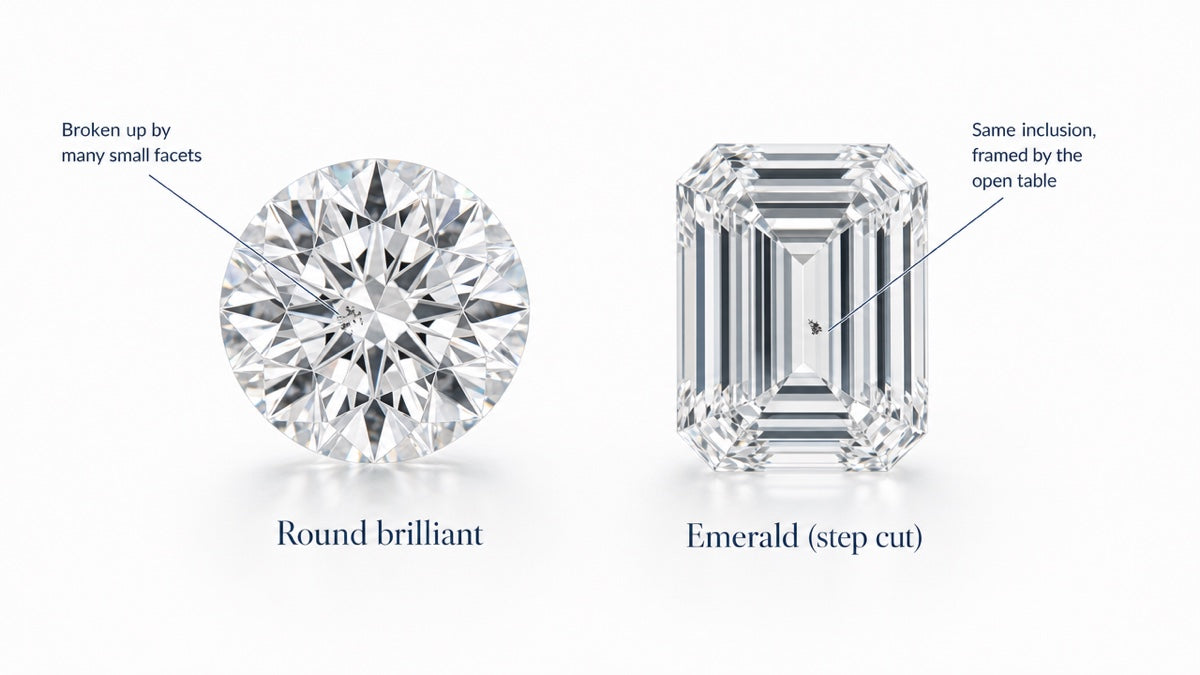
Brilliant cuts, like round, oval, cushion and radiant, have many small facets that scatter light and help disguise inclusions, especially near the edges and points.
Step cuts, like emerald and Asscher, work differently. Their long, flat, rectangular facets act like windows into the stone. An inclusion that would vanish in a round brilliant can sit in plain view in an emerald cut. Some fancy shapes, such as marquise and heart, also benefit from higher clarity.
Size adds to the effect. Larger stones have larger facets and a bigger table, so inclusions have more room to show. For emerald cuts, and for stones over about a carat, I usually start the search a grade or two higher than I would for a round of the same size.
Reading the clarity plot on a GIA report
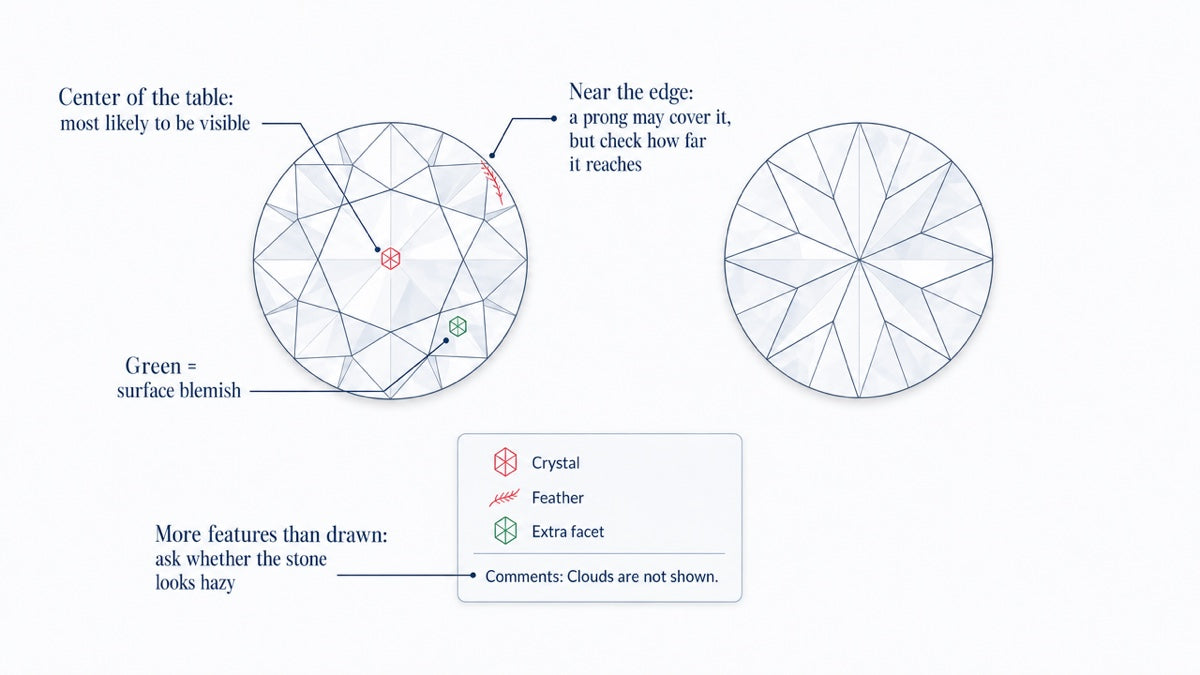
The clarity plot is a map of the stone's inclusions, drawn from the top (crown) and the bottom (pavilion). Internal features are shown in red, surface blemishes in green, and the key to symbols lists each type, usually beginning with the feature that most affected the grade.
How to read it:
- Location first. Something in the middle of the table is more visible than the same thing near the girdle, where a prong may cover it.
- Size and count. One small crystal and a scatter of twenty are very different stones, even at the same grade.
- Type. Pinpoints and needles are usually harmless. A large feather or a crystal belongs on a closer look.
- The comments section. Notes like "clouds are not shown" or "pinpoints are not shown" mean there are more features than the plot draws. Usually these mean nothing. Sometimes extensive clouds make a stone look slightly hazy or milky, and the plot alone won't tell you which. That is exactly when I want eyes on the stone.
Inclusions I steer clients away from
Some features cost a stone more than its grade suggests:
- Dark crystals near the center of the table. Light-colored inclusions blend in. Dark ones stand out.
- Clouds heavy enough to cause haziness. The grade can look fine on paper while the stone looks slightly dull in person.
- Large feathers reaching the surface, especially near the girdle. These aren't only a visual issue. A big feather at the edge can be a weak point if the stone takes a hard knock.
- Inclusions that reflect. In some stones, the facets mirror one inclusion into several, making it far more noticeable.
Also ask about treatments. Some diamonds are laser drilled to lighten a dark crystal, or fracture filled to hide feathers. GIA reports note laser drilling, and GIA does not issue grading reports for fracture-filled diamonds. I only place a center stone that comes with its GIA report, so a treatment would be documented there, not hidden.
Letting the setting do some work
The setting can quietly help with clarity:
- Prongs can sit over a small inclusion near the edge. That is easier to plan when I know the stone before the design is final.
- Bezels wrap the whole girdle, covering edge inclusions and protecting that area.
- Halos and hidden halos add sparkle around the center stone, which draws attention away from minor features. They don't make a visible inclusion disappear.
This is one reason custom work matters for a stone with a small inclusion near the edge. In the custom process, you approve renderings before anything is made, so the setting can be built around the stone you chose. If you would rather start from a classic shape, the engagement ring collection is a good reference point, and any piece there can be adapted.
Where to put the money instead
Clarity is the C you are least likely to see, so I usually aim for "eye-clean for this shape and size" and stop there. Then the budget goes in roughly this order:
- Cut. It drives sparkle more than any other C, and a poorly cut diamond looks lifeless at any clarity.
- Carat and color, by your priorities. Some people want size. Others notice warmth in a stone right away. Tell me which you are, and I'll show you where spending more changes nothing you can see.
- Clarity. Enough to look clean, and not a grade more unless the shape calls for it.
This is general guidance, not financial advice. If resale value or insurance coverage is part of your decision, talk with a qualified appraiser or your insurer.
Natural vs. lab-grown: clarity notes
Lab-grown diamonds have inclusions too, and the same visual logic applies. Location, size, darkness and shape matter more than the label. How grading labs describe lab-grown clarity on reports has been changing, so I'll walk you through whatever your stone's report says.
Lab-grown stones generally cost less than natural ones of similar size. That changes the math, because moving up a clarity grade costs less in absolute dollars. Whether that is better spent on clarity, size or the setting is your call. I'll lay out cost, resale and sourcing for both options without steering you toward either.
Ready to find a stone that looks clean without overpaying for it?
Tell me your shape, your rough budget and what you have been saving pictures of. I'll come back with GIA certified options, say the trade-offs out loud, and show you each stone on video before you decide. Start your ring here, or book a complimentary consultation in Austin or over video.