How to buy an engagement ring comes down to deciding what matters and in what order: your budget, the 4Cs, shape, setting and metal, then the GIA report. This guide explains where your money actually goes, how to read the paperwork, and how to keep a salesperson from making the decision for you. Most guides teach you the vocabulary and then send you to their inventory; this one doesn't.
I'm Karmen Archuleta. I hold GIA credentials in diamonds and gemstones, I'm an Accredited Jewelry Professional, and before I started KLA Fine Jewelry I was a Territory Manager for a diamond and gemstone manufacturer. I saw what happens to a ring long before it reaches a store. Here is the part worth knowing.
Step 1: Set a budget, and skip the myths
You've probably heard a rule about spending a set number of months' salary. It's a sales slogan, not advice. The right budget is the number you can spend without regret. Nobody else's formula applies.
What does help is knowing what drives the price. The diamond accounts for most of the cost of an engagement ring. The rarer its combination of quality factors, the more it costs. The setting matters, but the center stone is where your budget is won or lost.
A few things to decide before you look at a single ring:
- A range, not a ceiling you'll stretch. Tell your jeweler that range out loud. A good one shows you the best version of your number. A bad one shows you something just above it.
- What's fixed and what's flexible. Is size the priority, or a particular shape, or a metal? Knowing this tells you where to give a little.
- Where the money goes beyond the stone. In traditional retail, part of the price pays for the storefront, the inventory sitting in the cases and the sales staff. That isn't a scandal, but it's worth understanding when you compare prices.
The most useful budget conversation covers where spending more changes nothing anyone can see. There is a lot of that territory in diamonds.
This page is general information. For financing, insurance or anything with legal or tax implications, talk to a qualified professional.
Step 2: The 4Cs, in the order that matters
GIA developed the 4Cs (cut, color, clarity and carat weight) as a standard way to describe diamond quality. Each one describes a single factor. Three of them (cut, color and clarity) describe quality. Carat describes weight, which affects how big the stone looks.
Here is how I'd prioritize them for most engagement rings.
Cut first
Cut covers the diamond's proportions, symmetry and polish. It controls how a stone handles light, so it decides whether the diamond looks lively or flat. A well-cut diamond can look brighter and even larger than a heavier stone that's cut poorly. For round brilliants, GIA gives a cut grade from Excellent to Poor. This is the last place I'd economize.
Then color and clarity, up to "looks right"
Color is graded from D (colorless) toward Z (noticeable tint). Clarity runs from Flawless down to Included (I3) and describes how free the stone is of inclusions and blemishes.
The higher grades are rarer and priced that way. Many of those differences, though, are invisible once the stone is set and on a hand. The goal is a diamond that looks white in its setting and clean to your eye. Paying for grades only a lab can detect is a choice, not a requirement.
Shape changes this math. Step cuts like emerald and Asscher have large open facets that show inclusions more readily, so clarity matters more there. Some elongated shapes can show color at the tips. Metal matters too. Yellow gold is forgiving of a little warmth in the stone, while white metals can make a tint more noticeable.
Carat last
Carat is weight. Prices tend to climb at round-number weights because of demand. Size also depends on cut and shape, since two stones of the same weight can face up quite differently. If size matters to you, compare the millimeter measurements on the report, not just the carat figure.
Step 3: Shape and style
Shape is the outline of the stone: round, oval, emerald, pear, cushion, radiant, marquise and so on. Round brilliants are cut for maximum sparkle. Ovals, pears and marquises tend to look larger for their weight and lengthen the finger. Emerald cuts trade sparkle for long, glassy flashes and a cleaner, architectural look.
If you're buying as a surprise, look for clues. Check saved photos, the jewelry they already wear, and whether they lean toward clean lines or vintage detail. You don't need to know the names of shapes or settings to describe what you like. Pictures do that better than vocabulary.
Step 4: Setting and metal
The parts of a ring
The head holds the center stone, usually with prongs or a bezel (a metal rim). The gallery is the metalwork under the stone, visible from the side. The shank is the band itself.
Common settings, and how they live day to day
- Solitaire: one stone on a plain or simple band. The prongs leave room for light to reach the stone. It is the easiest setting to resize and to pair with a wedding band.
- Halo: a ring of small diamonds around the center, adding sparkle and making the center look larger.
- Hidden halo: small diamonds set under the center stone, visible mostly from the side.
- Three-stone: a center flanked by two side stones, often read as past, present and future.
- Pavé: small diamonds set along the band.
- Bezel: metal wrapped around the stone's edge. It is protective and sleek, and suits people who work with their hands.
Think about the wearer's day. A tall setting catches on sweaters and gloves. Six prongs hold a stone more securely than four, with a little more metal showing. Pavé bands are beautiful but have more small stones to look after.
Metals
Engagement rings are usually yellow, white or rose gold, platinum, or a mix. Platinum and white gold are the two main white-metal choices. They wear differently. White gold is typically plated for its bright white finish, and that plating wears over time and can be refreshed. Platinum develops a soft, satin-like patina that some people love and others have polished away. Yellow and rose gold are forgiving of daily scratches, and their warmth flatters a near-colorless stone.
Step 5: How to read a GIA report
GIA is an independent, nonprofit lab that doesn't buy or sell diamonds. That's why its report carries weight. Quality differences between diamonds can be too subtle to judge reliably without lab verification, so insist on a report from an unbiased lab. Every center stone I set is GIA certified, and you review the report before you say yes to the stone.
Here's what to look at, section by section.
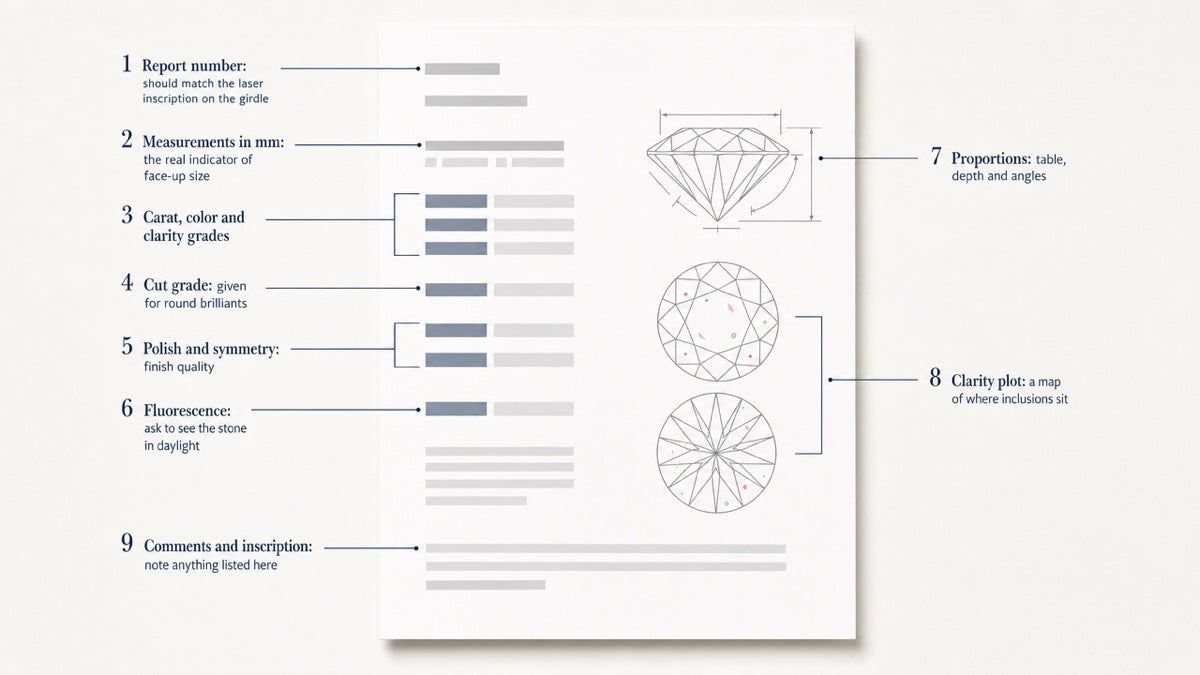
- Report number and inscription. Many diamonds are laser-inscribed on the girdle (the thin outer edge) with their report number. Check that the number on the stone matches the report. It also helps identify the stone if it's ever lost or stolen.
- Measurements. These are given in millimeters. They tell you how big the stone will look far better than the carat weight does.
- The grades. Carat, color and clarity, plus a cut grade for round brilliants.
- Polish and symmetry. These describe the finish and how precisely the facets align. Strong grades here support the stone's overall cut quality.
- Fluorescence. This is a glow some diamonds show under UV light. Usually it has no visible effect in normal light. If a report lists strong fluorescence, look at the stone on video in daylight before deciding.
- Proportions diagram. This shows table size, depth and angles. It is useful for comparing two stones with similar grades.
- Clarity plot. This is a map of the inclusions. Inclusions near the edge can sometimes hide under a prong. Inclusions in the center can't.
- Origin and treatments. The report confirms whether the diamond is natural or laboratory-grown and notes treatments.
One caution: a report describes a stone, and an appraisal values it. They're different documents, covered below.
Step 6: Natural or lab-grown
Lab-grown diamonds are real diamonds with the same physical properties as natural ones. Telling the two apart takes specialized training and equipment. GIA has graded lab-grown diamonds since 2007. Its reports for them state the growth method (CVD or HPHT) and note any treatment after growth to change color. Sellers are expected to disclose clearly when a diamond is lab-grown.
The honest trade-offs:
- Cost. Lab-grown stones cost less for the same size and grades. Many people put the difference toward a larger stone or a better setting.
- Resale. Lab-grown diamonds don't hold their value the way natural diamonds tend to. Be realistic about resale for either type, though. Selling any diamond typically returns far less than you paid.
- Sourcing and meaning. Some people value a natural diamond's geological age and rarity. Others prefer how a lab-grown stone is produced. Both are legitimate reasons.
I work with both and won't push you toward either. You'll also see simulants like moissanite in other guides. Moissanite is not a diamond. It's silicon carbide, slightly less hard than diamond, and durable enough for daily wear.
Step 7: Get the ring size right (or close enough)
The most accurate way to size a finger is a proper ring sizer. A borrowed ring or a traced circle only gives an approximation, because sizes differ from finger to finger and hand to hand. If it's a surprise, a ring the wearer already wears on the same finger is a reasonable starting point.
Don't let an unknown size stop you. Most rings can be resized roughly two sizes up or down. A plain solitaire band is the simplest to adjust. Pavé or stones set around the band make resizing more complicated, and full eternity bands generally can't be resized at all. I offer complimentary sizing on rings. For custom work, we can design around an unknown size and correct it later.
Step 8: Plan the wedding band now
This is the step most people skip. The engagement setting decides what kind of band can sit next to it.
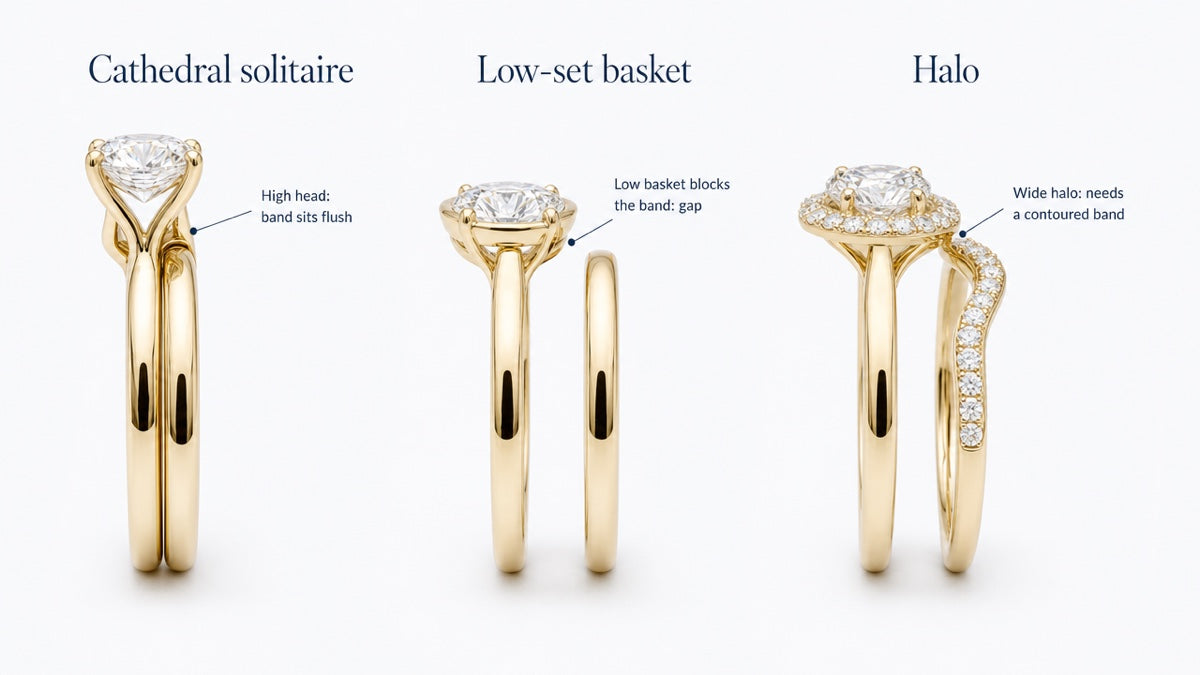
Settings that sit low or spread wide, such as some baskets, halos and wide side stones, can leave a gap with a straight band. You'd then need a curved contour band or a custom-fit one. Settings with more height underneath usually let a straight band sit flush. Ask to see the two together, even as a rendering, before you approve the engagement design. A half-eternity band, with stones across the top only, sits neatly against a solitaire and is easier to resize than a full eternity.
Step 9: Online, in person, or a concierge jeweler
Each route has real strengths.
- Large online retailers offer huge selection and easy comparison by report. The trade-off is that you're judging a diamond from a screen, with no person accountable for the whole ring. If you go this way, consider only stones with a report from a reputable independent lab.
- Stores let you try on shapes and settings and see stones in person. That's genuinely useful. You're limited to what's in the cases, though, and the experience can come with pressure to decide on the spot.
- A concierge jeweler works with you one-on-one and sources stones to your budget rather than from stock. I'm a concierge jeweler, so take this with that in mind. The advantage is that one person is accountable from the first conversation to the finished ring. With me, that means you see the GIA report before approving the stone and get video of your actual stones and renderings before anything is made. The honest limit is that I don't run a showroom with cases to browse. If you want to try on a dozen shapes first, do it, then bring me what you learned.
How custom works lays out the steps. Roughly, it's about two weeks for the consultation and stone selection, then four to six weeks from design approval. I also keep a few engagement ring styles ready to customize.
Wherever you buy, a few questions protect you from pressure. Ask to see the report before deciding. Ask what you'd gain by spending more and what you'd see by spending less. Ask whether you can take a day to think. Anyone who resists those questions is telling you something.
Step 10: Appraisal, insurance and care
An appraisal estimates a ring's monetary value based on its quality and current market conditions. Insurers typically rely on a replacement value. Every custom piece I make arrives with a detailed appraisal for insurance in the box. Independent guidance recommends an appraiser with no stake in the sale. If you want a second opinion, getting one is reasonable and I'll never mind.
On insurance, people commonly choose between a standalone jewelry policy and adding the ring to a homeowner's or renter's policy. Ask whether a claim pays replacement value or actual cash value, whether there's a deductible, and whether you can choose who repairs or replaces the ring. Values change over time, so plan to update the appraisal periodically.
For daily care, take the ring off for heavy lifting, gardening and harsh cleaners. Clean it at home with warm, soapy water and a soft brush behind the stone, where grime collects and dulls the sparkle. Have the prongs checked regularly. I'll inspect them twice a year at no charge.
Ready when you are
You don't need to know shapes, settings or a ring size to start. Send me the pictures you've saved and a rough budget. I'll tell you plainly what's possible, including if I'm not the right jeweler for it. Consultations are complimentary, in Austin or over video.