How much custom jewelry costs comes down to what its materials and labor cost, and you control most of that. The center stone usually leads the price, with the metal, accent stones and the work in the setting adding to it. I know that isn't satisfying when you just want a number. So here is what actually moves the price and where you have room to choose. Then you can walk into a conversation with a budget that makes sense, whether that conversation is with me or with someone else.
Why custom pieces don't come with a price tag
A ready-made ring has a price because every decision about it has already been made. A custom ring doesn't exist yet. Two oval engagement rings that look alike in a photo can be very far apart in cost, depending on the stone's size and grades, the metal, and how much work goes into the setting.
You'll notice my portfolio shows finished rings without prices. Seeing what someone else paid for their 3.55-carat oval tells you nothing useful about yours. It can also make a perfectly good budget feel small before you've said it out loud. What matters is your number and your priorities.
What you get instead of a list price is a quote built around you. You send pictures and a rough budget. I come back with what's possible at that number, and you see the price before you commit to anything.
What actually drives the price
The center stone
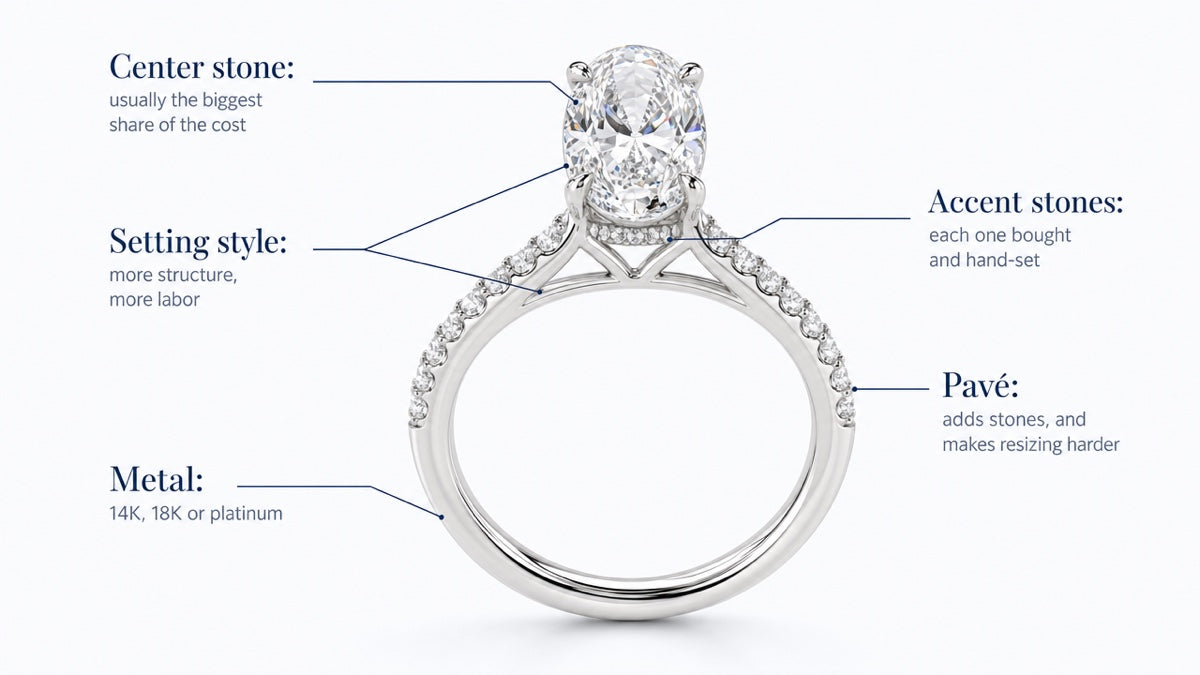
For most engagement rings, the center stone is the largest single cost, and its quality largely sets the price of the ring. Its size, color, clarity and cut all count, and so does whether it is natural or lab-grown. Those are covered below, because that's where most of your room to adjust lives.
The metal
Common choices for fine rings are 14K and 18K gold in yellow, white or rose, and platinum. Platinum generally costs the most because it is rarer and denser. It is also valued for being hypoallergenic. Don't choose metal on price alone, though. The color of the metal changes how the stone reads. Yellow gold can warm a diamond, and white metals keep it looking icy.
Accent stones and detail
Side stones and small pavé diamonds add cost, because every one is a stone that has to be bought and then set by hand. Details like milgrain, filigree or engraving add labor. A simple prong solitaire is usually the most economical design. Halos, three-stone rings and pavé bands cost more for the extra stones and the extra hours.
Labor and complexity
Design time, rendering, casting, setting and finishing all count. A clean four- or six-prong head is quick for a skilled setter. A hidden halo, a cathedral setting with an accented bridge, or a band set all the way around takes longer, and that time is part of the price. Complexity also affects later costs. Continuous pavé, for example, is harder to resize than a plain band.
Where the 4Cs give you room
Diamonds are graded on four things. Color is how colorless the stone is, clarity is how free it is of inclusions, cut covers its proportions and symmetry, and carat is its weight. Together they set how rare a stone is, and rarity sets the price. The useful part is that you rarely need the top of every scale.
- Clarity. Flawless and internally flawless stones command the highest prices. Many inclusions are microscopic, though, and a VS2 or sometimes SI1 stone typically has nothing you can see without magnification. That is often the best value on the scale.
- Color. G and H are near-colorless and cost noticeably less than D through F. Once the stone is set, and especially in yellow or rose gold, most people can't tell the difference.
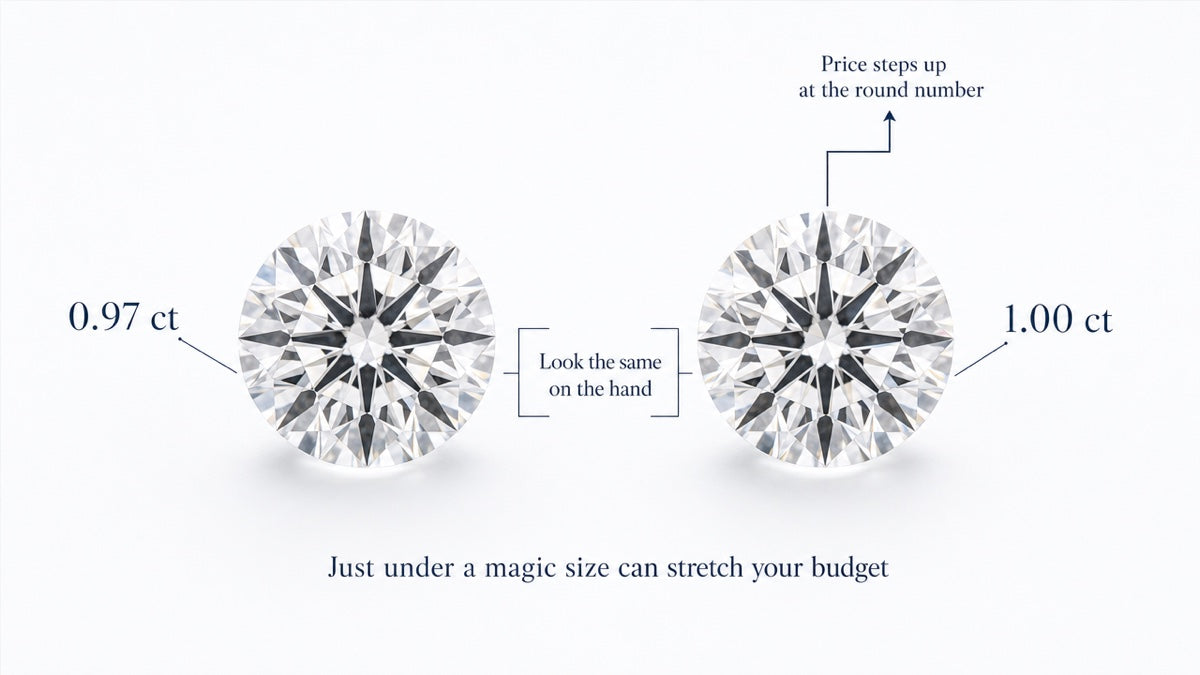
- Carat. With everything else equal, price climbs steeply as weight goes up. Prices also jump at "magic" sizes. A 0.97-carat stone can cost meaningfully less than a 1.00-carat one, and the two look essentially the same.
- Cut. This is the one I'd protect. A slightly smaller diamond with a better cut often looks more striking than a bigger one that's cut poorly.
If size matters most to you, you can keep it within budget by accepting a little lower color or clarity. If you want a stone that's whiter and cleaner, you can come down slightly in weight. Decide together which C matters most before you look at stones.
Grades on paper don't tell the whole story. Two stones with similar grades can look different, and two that look alike can be priced far apart. That's why I show you video of each option I source, along with its GIA report, and say the trade-offs out loud.
Natural or lab-grown
This choice changes the price more than almost anything else. Lab-grown diamonds generally sell for meaningfully less than mined diamonds of similar size and grade. One gem industry guide puts the difference at roughly 30%. They have the same beauty and durability, and you can't tell them apart without their grading reports.
What to weigh beyond the price:
- Resale. Neither kind reliably holds its value. Selling either one typically returns far less than you paid, so treat both as something to wear, not an investment.
- Sourcing. Some people care deeply about where a stone came from or how it was made, and that's worth deciding for yourself.
- What the savings buy. Many of my clients put the difference into a larger stone or a better setting.
I work with both. I'll lay out the cost, resale and sourcing differences side by side, and I won't steer you toward either one.
Reusing heirloom stones
Building a new piece around stones you already own can lower the cost, because the most expensive part may already be paid for. It isn't automatically cheap, though, and not every stone should be moved.
Before anything is reset, the stones need a careful look. Older diamonds can have chips, worn edges or cuts that sit differently in a modern setting. Taking a stone out of an old mounting carries some risk, more so for softer gemstones or stones that already have damage. A stone that has never been graded may also be worth documenting before it goes into something new.
Bring the piece in or send photos. I'll tell you plainly what can be reset safely, what should be left alone, and whether your stones suit the design you have in mind. You can also pair family stones with a newly sourced center stone.
Ready-to-wear vs custom pricing
Ready-to-wear pieces carry a fixed price because the design, metal and stones are already settled. In my shop, for example, the Classic Solitaire Ring is listed at $3,499 and the Pavé Half-Eternity Band at $1,299. Across the industry, preset rings are generally cheaper to produce because they're made in quantity. Custom work is generally more expensive because it adds design time and one-off craftsmanship.
My setup narrows that gap. I have no storefront, no large inventory and no sales staff, so there's no traditional retail markup built into what you pay. A custom ring from me can come out closer to retail ready-made pricing than you might expect. I won't promise it will be cheaper, though, because that depends entirely on what we build.
There's also a middle path. Any shop piece can be adapted with a different stone, a different metal or a different length. I'll price the change before you commit.
What the process includes
The custom process has four steps:
- Consultation. It's complimentary and there's no obligation. We meet in Austin or over video.
- Stone selection. I show you GIA-certified options inside your budget, with the trade-offs explained.
- Design approval. You see renderings of the ring from every angle. Nothing is made until you say yes, and changing the design costs you nothing but a little time.
- Production. The ring is made, set and inspected, then delivered or shipped insured.
Plan on about two weeks for the consultation and stone selection, then four to six weeks from design approval.
Every custom piece arrives with an appraisal in the box. Shipping is fully insured at no charge, and sizing on rings and bracelets is complimentary. Insuring the ring afterward is a separate cost between you and your insurer. This page is general information, so for insurance or financing decisions, talk with a qualified professional.
Setting a realistic budget
- Pick your priority. Decide between size, whiteness, clarity and design detail, or rank them. That ranking shapes everything else.
- Choose a number you're comfortable with, and say it. A range is fine. I'll show you the best version of it, including where spending more changes nothing anyone would see.
- Leave room for extras. Engraving, a rush if your date is tight, and insurance after delivery can all add to the total.
- Mention your date early. I'll tell you honestly whether it's realistic.
- Gather pictures. Screenshots are the most useful thing you can send. You don't need to know setting names.
Tell me your number
If you're weighing a custom ring or a redesign, send me your pictures and a rough budget. It takes about two minutes. I read every request myself and reply within 24 hours with what's realistic at your number. If I'm not the right jeweler for it, I'll say so. More answers are on my FAQ page.