To upgrade your engagement ring, you can reset your stone in a new setting, redesign the whole piece, or choose a new center stone. The ring you said yes to doesn't have to stay exactly as it was. Some people want something new for an anniversary. Some have a stone sitting in a setting that's worn out. Some have inherited a grandparent's diamond and want to wear it every day instead of keeping it in a drawer.
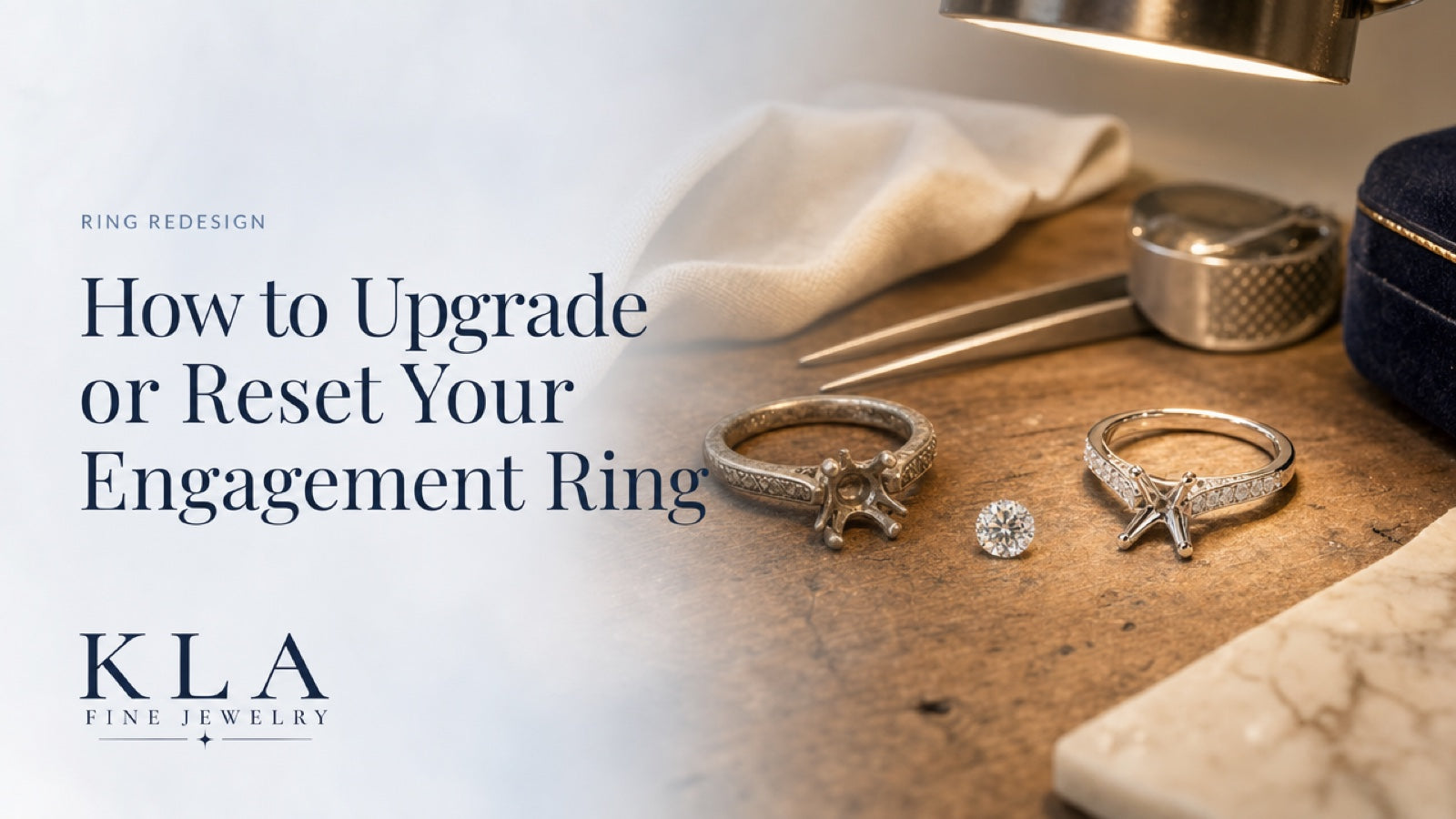
Most of this work starts with something you already own, and that changes the decisions. Below is how I think it through with clients, from the first question to the day the new piece arrives.
Signs it's time
You don't need a reason beyond wanting a change. These are the ones I hear most:
- The setting is tired. Prongs look thin, the stone shifts, or the ring catches on everything.
- Your taste has moved on. A style that felt right years ago now feels dated to you.
- A milestone. An anniversary, a new chapter, a moment you want the ring to reflect.
- It doesn't suit how you live. It sits too high for work, or you'd rather it sat lower against the hand.
- An heirloom you never wear. It's beautiful and meaningful, but it isn't you.
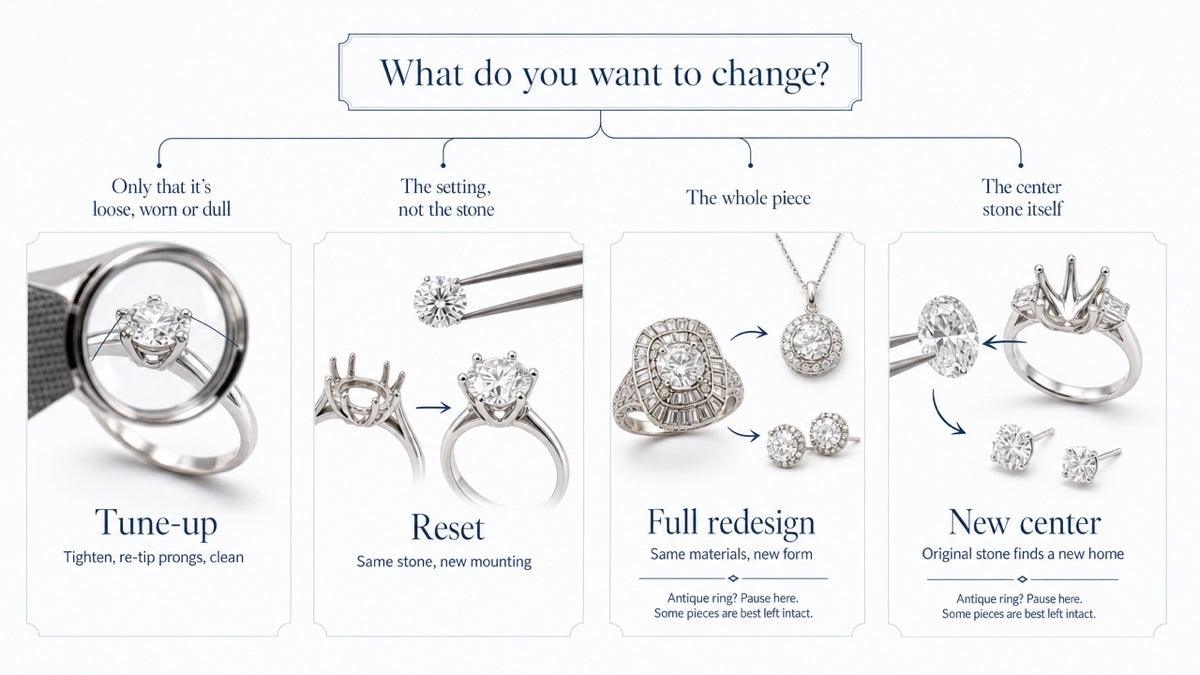
Before you redesign anything, rule out the simplest answer. Sometimes a ring only needs a tune-up: tightening loose stones, re-securing prongs and a proper cleaning. Older pieces can also carry a patina, a darkened film on the metal. Some owners want it removed and some love it, so tell your jeweler which you prefer. I repair jewelry whether or not I made it. If a tune-up is all your ring needs, I'll say so.
Reset, redesign or a new center
These three paths get blurred together. They lead to very different places.
Reset: same stone, new setting
You keep your center stone and move it into a new mounting. It's the most direct way to change how a ring looks and wears without changing what it means. A dated setting can become a clean solitaire, a three-stone or a hidden halo.
Full redesign: same materials, a different piece
The stones, and sometimes the metal's role, get rethought from scratch. An heirloom ring might become a modern engagement ring. A large cocktail ring or brooch might become a pendant with matching earrings. Stones from one family piece can also be divided among siblings or relatives, so each person ends up with a piece of their own to pass down.
A new center stone
Here the center itself changes, usually larger or a different shape. You can set new stones into the existing ring, or build something new around a new center. The original stone doesn't have to disappear. It can become studs, a pendant or a side stone.
If you're choosing a new center, I offer both natural and lab-grown diamonds. I'll walk you through the differences in cost, resale and sourcing, and the choice is yours. One caution: if the ring is a genuine antique, swapping its center can erase the character that made it special in the first place.
Reusing existing and heirloom stones
This is some of my favorite work. It deserves a careful start.
Know what you have. If you don't know an heirloom's historical or monetary value, have it assessed by a jeweler or appraiser before anything is altered.
Consider a lab report. If a stone has no grading report, an independent lab can document what it is, whether it's natural or laboratory-grown, and any detectable treatments. That matters more than it sounds. Knowing how a gem was treated tells the jeweler how to handle it safely during setting and cleaning, and it helps an appraiser value it correctly later.
Expect to add or leave out. A redesign sometimes needs a few added diamonds or gemstones to get the look right. Not every original stone may fit the new design either. Decide early what happens to the leftovers. They can become earrings, a pendant, or a gift to another family member.
Check the stone's condition before it comes out
Old stones take knocks over decades, and some damage stays hidden under prongs until the stone is unset. Bring the piece to me first, and I'll tell you what can be reset safely and what I think should be left alone. Go in knowing that once a vintage piece is taken apart, it can't be put back the way it was.
Old cuts: recut or keep as-is
Older diamonds often have cutting styles that look different from today's: softer, chunkier, warmer in candlelight. Recutting can bring a stone closer to modern proportions. It also removes weight and some of the history you may be keeping it for. Many people find the old cut is exactly what they love. If recutting is on the table, weigh what you'd gain against what you'd lose, and don't rush it.
Adding side stones or a halo
Side stones and halos are the most common ways to add presence without replacing the center. A halo, a ring of small diamonds around the center, makes the center look larger than it is. A hidden halo sits under the stone and shows mostly from the side. Three-stone designs flank the center with matching or contrasting stones, and they're a natural home for family stones.
Will your wedding band still fit?
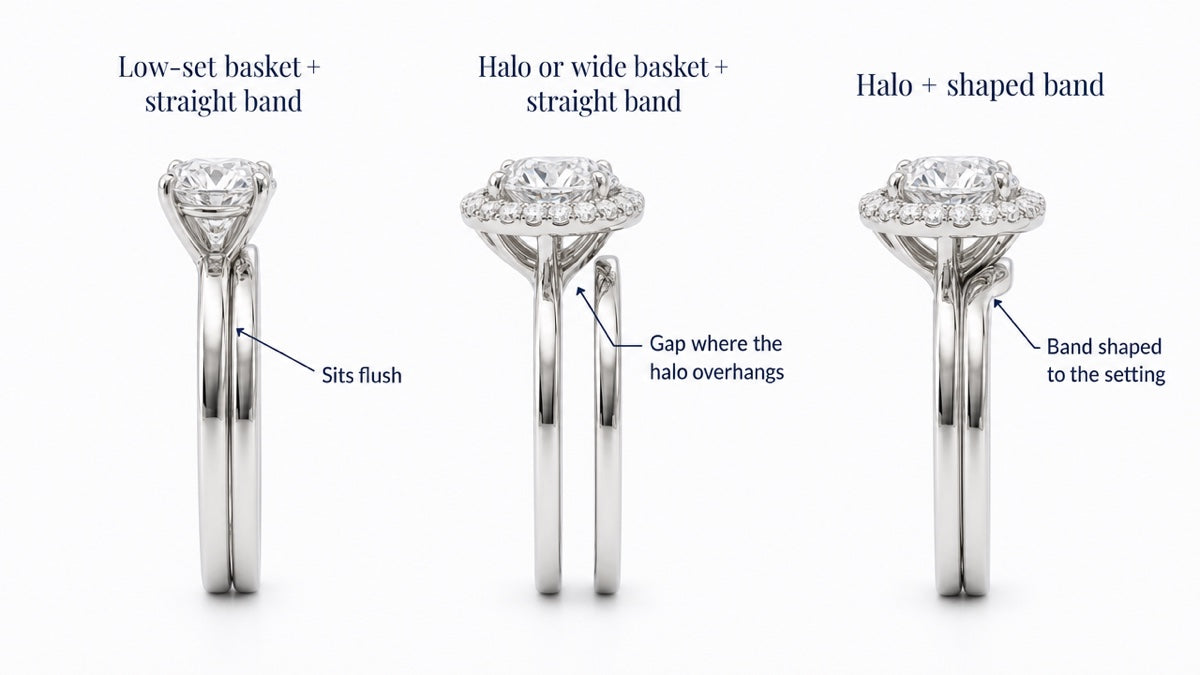
This is the question people forget to ask. A taller setting, a halo or a wider basket can change how your band sits next to the engagement ring. It can leave a gap or push the band off at an angle. The options:
- Design the new setting low enough that a straight band sits flush. A half-eternity band, with stones across the top only, is built to sit flush with a solitaire.
- Make a band shaped to curve around the new setting.
- Plan the engagement ring and band together, so neither is an afterthought.
If you're also resizing, know that eternity bands with stones all the way around may not be resizable. Moving many styles more than two sizes can distort the ring or loosen stones. Raise sizing at the start and it shapes the design instead of complicating it.
Changing the metal
A new metal can transform a ring on its own. A colorless diamond set in platinum or white gold looks whiter and more contemporary. Yellow gold reads warmer and more classic. Colored stones respond too, and a ruby can glow in yellow gold. I work in white, yellow and rose gold as well as platinum. If your stones were bought to suit one metal, I'll tell you honestly how they'll look in another before you commit.
Budgeting for an upgrade
There's no formula you're supposed to follow. Old rules of thumb about engagement ring spending aren't the standard anymore. Pick a number you're comfortable with, and if you share finances, a number you're both comfortable with.
Reusing a stone you already own changes the math. Setting new stones into an heirloom ring, or repurposing its stones into a new design, can both stretch a budget, because much of the cost of a ring usually sits in the center stone. When you tell me your number, I'll show you the strongest version of the ring at that number. I'll also point out where spending more wouldn't change anything anyone can see. You'll know what something costs before you commit, and adjusting a design along the way costs you only time.
How the process works, and how long it takes
- Tell me what you're imagining. Send photos of your current ring and anything you've saved that you love. We meet in Austin or over video. The consultation is complimentary, with no obligation.
- Stones. We look at your existing stones together. If you're adding or replacing any, I source GIA certified options inside your budget and talk through the trade-offs. Consultation and stone selection take about two weeks.
- Renderings. You see CAD renderings of the ring from every angle and we adjust until it's right. Nothing goes into production without your approval.
- Making it. About four to six weeks from design approval, the piece is made, set, inspected and filmed. Then it's hand-delivered or shipped insured.
If you have a date in mind, tell me early. I'll tell you honestly whether it's realistic. You can see finished resets and custom pieces in the portfolio, and read more about how custom design works.
Update your paperwork afterward
A reset or upgrade changes what your ring is, and often what it's worth. An old appraisal describes a ring that no longer exists. Every custom piece I make arrives with a detailed appraisal in the box, ready for insurance. Send it to your insurer and ask whether your policy needs updating to reflect the new piece. Also ask whether they need any other documentation, such as an independent appraisal. If your ring isn't scheduled or separately insured, ask what your current policy actually covers. This is general information. For coverage questions, talk to your insurance agent or a qualified professional.
The emotional side
This is often the hardest part, and it's worth taking slowly.
Many people feel uneasy resetting a stone from a relative who's still living, even with that person's blessing. There's no etiquette rule here. A conversation usually helps more than guessing. Some families like knowing a stone will be worn daily. Others want the original kept as it is.
Leaving a piece intact is a real option too. The next generation may want the original exactly as it was. If you're unsure, a tune-up lets you wear the ring now and decide later.
When a redesign does go ahead, small choices can carry the story forward. You can keep the original setting, give leftover stones to a sibling, or add a detail that echoes the old ring.
Ready to talk it through?
Bring the ring, or a photo of it, and whatever you've saved that you love. You don't need setting names or a finished plan. Start here, and I'll reply within 24 hours with what's possible.