To match a wedding band to your engagement ring, look at how the engagement ring is built underneath the stone, because that decides whether a band sits flush, needs a contour, or leaves a gap. Most people choose the engagement ring first and only think about the band later, then slide one on and find a gap, a tilt, or two rings that seem to argue with each other.
Whether a band sits flush is not luck. It depends on how the engagement ring is built underneath the stone, and you can check that before you buy. Below is how I think it through: order, fit, metal, and then the years of wear.
Which ring goes first
The traditional order
Traditionally, the wedding band goes on the ring finger of the left hand first, closest to the heart, and the engagement ring rests above it. That order also suits the ceremony, because the band goes on before the engagement ring returns to the finger.
Reverse stacking
Plenty of people put the engagement ring at the base and the band on top. Some like how it looks. Some prefer the larger ring anchored lower on the finger. Others rotate the order depending on the day. Neither order is wrong. One practical note: when your rings are different widths, the thickest one usually feels most comfortable at the bottom.
Separate fingers, or separate days
You don't have to stack at all. Some people wear the engagement ring on the right hand and the band on the left, for comfort, work or cultural custom. Others wear only the band day to day and save the engagement ring for evenings out. Someone who wears gloves at work, for example, may find a raised setting snags while a plain band doesn't.
Wearing the rings apart solves fit and rubbing problems completely. The trade-off is that you give up the look of the two rings together.
Why some bands sit flush and others don't
Hold your engagement ring at eye level and look at it from the side. That profile view tells you more about band compatibility than any photo taken from above.
What matters is everything under the stone:
- The head or basket. This is the metal cup and prongs holding the center stone. On a low-set ring, the basket can reach down to the band line. A straight band then bumps into it and stops short, which leaves a gap.
- The gallery. This is the open metalwork beneath the stone. When the setting is lifted so the gallery clears the shank, a straight band can slide right underneath.
- Hidden halos, cathedral shoulders and split shanks. Each one adds metal or width near the band line. All three are beautiful, and all three can push a straight band away.
- Stone shape. Pear, marquise and wide ovals, especially inside a halo, often extend past the edges of the shank.
Before you commit, ask the jeweler directly: "Will a straight band sit flush with this? If not, what will?" If you're shopping online, ask for a side-view photo or video with a band beside the ring.
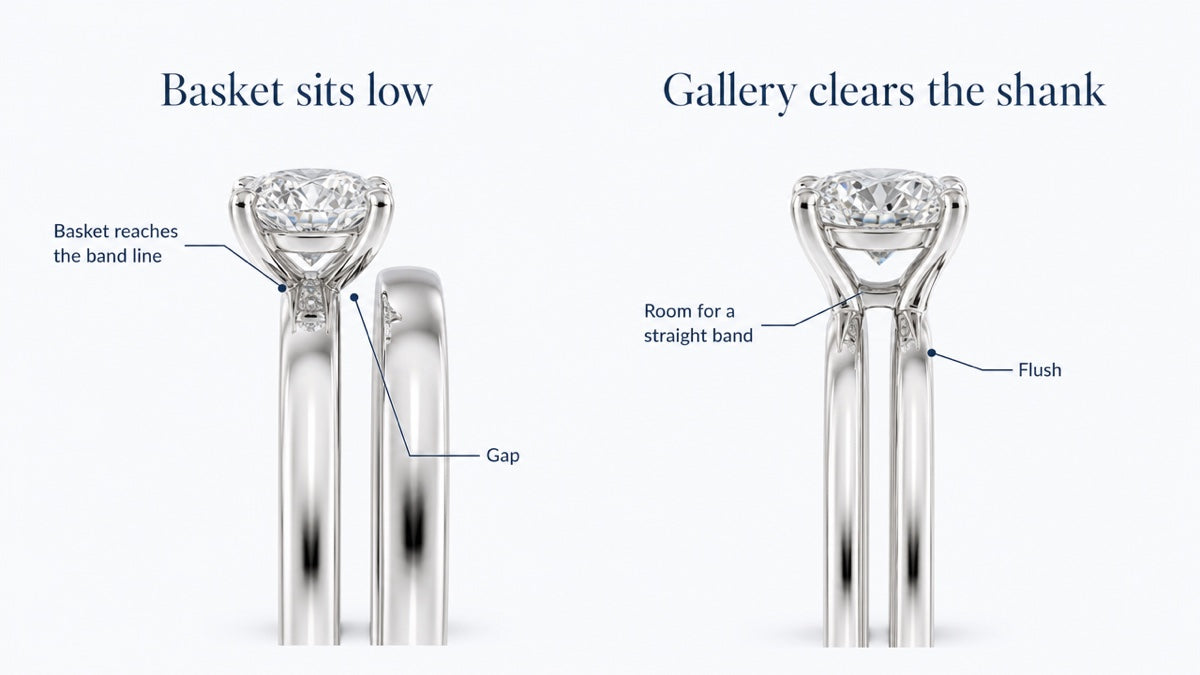
A small gap isn't a defect. Some people like the breathing room between the two rings. It only becomes a problem if it bothers you or lets the rings spin and knock into each other.
Contour, curved and open bands
When a straight band can't sit flush, the band can change shape instead.
Contour bands are curved or notched so they wrap around the center stone or halo. They're the usual answer for pears, marquises and haloed ovals. Chevron and V-shaped bands follow a point or a peak. Open bands leave a deliberate gap at the top, framing the engagement ring rather than touching it.
Here is the honest trade-off. A contour band fits one ring. Worn alone, the curve can look like something is missing, and it limits swapping in other bands later. A straight band that works with your setting gives you more freedom.
A band designed for a specific engagement ring also keeps diamond sizes consistent and lines up how far the stones run down each side. That's why matched sets read as one piece.
When the band you have doesn't sit flush
If you already own both rings and they don't get along, you have options. Each one costs you something.
- Leave the gap. You give up nothing structurally. You may see some spinning.
- Add a spacer or buffer band. A thin plain ring between the two can fill a gap visually and keep the rings from grinding on each other. It adds width to the stack.
- Reshape the band. A plain metal band can sometimes be contoured or notched. Cutting into a band removes metal, though, and a band set with stones often can't be reshaped without disturbing them. I'll look at the actual ring before saying yes.
- Replace the band with one designed around your engagement ring. This takes the most effort, and it gives the cleanest result.
- Solder the two together. This stops them spinning out of alignment and stops them rubbing each other down. Afterward they're sized as one unit, and you can no longer wear either ring alone.
Mixing metals and textures
Matching metals is the simplest route to a cohesive set. You can also tie rings together with one shared detail, like matching milgrain or the same setting style. Mixing is fine too, and contrast can be lovely: a polished band against a matte or hammered ring, or a delicate diamond band next to something chunkier.
Metal hardness matters, though. Softer gold can wear faster when it rubs against harder platinum. A 14k gold band sitting below a platinum ring could thin over time. A buffer band or soldering helps if you want that combination.
As a general guide, the band should support the engagement ring rather than compete with it. A thin, detailed band such as micro-pavé suits a large solitaire. The Pavé Half-Eternity Band is built to sit flush with a solitaire. Its stones run across the top half only, which also makes it kinder to resize. For a lighter, more playful pairing, the Diamond Bubble Band scatters diamonds across polished gold. Both are in the wedding bands collection.
Leaving room for anniversary bands
Many people add a third ring later, often an eternity band for a milestone anniversary. It usually sits above the engagement ring, and the three together are said to represent past, present and future. An anniversary ring can also go on the right hand for balance, or mark another event entirely, like the birth of a child.
If you think more bands are coming, plan for them now:
- Leave space before the knuckle. Choose a first band that leaves comfortable room.
- Expect a tighter fit. Several rings on one finger can feel snugger than one, so a stack may need a size adjustment. Rings should sit snugly without rotating much and without restricting circulation.
- Watch the count. Three to five rings per hand is often cited as a balanced look. Past that, stacks can get uncomfortable and cluttered.
Wedding day ring logistics
A common approach is to move the engagement ring to your right hand before the ceremony. That way the band goes on an empty left ring finger. Afterward, move the engagement ring back above the band, or below it if you stack in reverse. Some people leave the engagement ring with someone they trust for the day.
A few practical checks:
- Decide who holds the bands, and confirm they have them before you walk out.
- Try both rings on together a few weeks ahead. Fingers change size with temperature, and an outdoor summer ceremony can make a snug ring feel tighter.
- If you're soldering, do it after the wedding, since the band has to go on by itself first.
Living with two rings: wear and care
Two rings on one finger rub constantly. Diamonds in a band are harder than the metal of the ring next to them, so an unsoldered pair can slowly wear each other down. That's the main reason people choose a buffer band or soldering.
For everyday care:
- Clean them at home. Use warm water, a drop of dish soap, and a soft brush at the back of the setting, where dirt blocks the light. Avoid bleach, chlorine and ammonia.
- Take them off when it makes sense. Remove them for swimming, since cold water can shrink fingers. Remove them for heavy work or harsh chemicals too.
- Store them separately. A soft pouch or lined box keeps them from scratching each other.
- Have the prongs checked. Prongs loosen with wear. If you're near Austin, bring your rings by twice a year and I'll check the prongs at no charge.
Designing both rings together
The easiest way to get a flush fit is to plan for the band while the engagement ring is still a drawing. When I know a band is coming, the setting height, the gallery and the shank width can all be shaped with it in mind. You approve renderings before anything is made, so you can see how the profile works first.
Custom work starts with a photo of what you love. Consultation and stone selection take about two weeks. Production takes four to six weeks from design approval. You can read how the whole process works on the custom design page.
If you already have an engagement ring, from me or anywhere else, send me photos of it, including one from the side. I'll tell you honestly what will sit well next to it.
When you're ready, start your ring here or book a complimentary consultation, in person in Austin or over video.